 Well, here I am, my first night as a medical student -- a medical anything, for that matter -- on call. In point of fact, it may not turn out to be much since I'm covering for an outpatient pediatrics practice. Most likely, any parent ringing up tonight will get the nurse practitioner who will triage the case and we'll see the child tomorrow. My job is to keep tabs on the E.R. and it's one I share with my attending
In the event a patient's parent decides tomorrow is not soon enough for Johnny or Joanie to be seen, my attending will get a call from the E.R. informing him it's time to awaken me from a sound sleep and get my eager backside down the hill from the apartment I share with another osteopathic medical student, and perform an evaluation. Then, on the assumption my attending's presence is legitimately required, I'll call back and summon him from hearth, home, and his spouse's warm feet, to join me in a game of Guess What I'm Sick With?
Should he decide his presence is not absolutely essential and his confidence in me well-placed after all, he may simply confirm my diagnosis and treatment plan, and inform the E.R. doc to implement the orders he's asked me to write and intends on signing first thing in the morning. The real morning, that is, when sane people are supposed to get up, not at 3.00 AM when night owls, insomniacs, and medical students prowl the streets looking for trouble in all the right places.
How all this came about is, I've been doing my pediatrics rotation out here in Western Massachusetts, in the Berkshire Mountains, and my assigned attending physician has taken a week off. No, it wasn't me, this has been in the hopper quite some time. So, she asked a colleague to take me on for a week and he does his own call. Noting the eager gleam in my eye when he mentioned this tidbit, naturally he didn't want to disappoint. And the truth is, I've been looking forward to tonight since my internship days in Boston, and there was no way I was going to let him have all the fun.
So, we shall see how the night unfolds. I may not do a thing. Then again, it's a full moon and as psychiatric mythology would have us believe, anything goes. It doesn't really and psych admissions are no more prevalent on full moon evenings than they are on Friday the Thirteenth. It just feels cool to say it that way and have the uninitiated think we're cool for being in the E.R. when anyone with a lick of sense would be in bed, sound asleep. But I'm not dozing this one out in an on-call room; I'm snug as a bug in my little alcove of a bedroom one step off the kitchen, where I'll be be until duty calls. Or my attending. whichever comes first.
(Photo of Berkshires Medical Center copyright 2011 by the author)

 So, tomorrow begins my rural community health rotation, which basically means private family practice in a rural area. I've always thought that was a bit of an inside joke since the entire state of Maine is classified as rural, but I'm probably splitting hairs. From the standpoint of population, my last rotation was actually more rural, since tomorrow's is only six miles from a town of eight thousand. I'm probably splitting hairs, again. I think the idea is to get me somewhere off the beaten path.
You might be wondering why I'm doing a rotation like this in the first place. The most obvious reason is because, well, I have to. While rural medicine is an elective at other medical schools, mine requires it. We train mostly primary care physicians and the average patient, if we decide to practice in Maine, will likely resemble those we see on this rotation. It's also a way of getting students out of their comfort zone, though for me, rural life is like biscuits and gravy. I was raised in the country and practically learned "down home" before English.
As to what I'm expecting, it's going to be family practice. Lots of colds, flu, and diarrhea. There may be opportunities to learn how to suture cut fingers and I suspect, like most family docs, my guy is also the local shrink. That will be fun. I'm hoping for a chance to get my physical exam skills back up to speed and use the OMM skills I've been practicing the past month. And I hope my preceptor eventually feels comfortable enough to allow me to work up a few patients on my own.
For most students, rural medicine seems to come along later in the rotation cycle, so they've had a chance to learn a few things before showing up at "Doc Hollywood's" front door. Because I had to retake boards, my cycle is slightly different, so rural medicine is my opportunity to get into shape before diving into the hospital madhouse routine. I'm not sure one way is better than the other, it's simply the way things are. I'm just glad to have boards behind me and be seeing patients for a change.
From the perspective of my dog and cat, this will be a lot easier than the PASS Program. Last fall, as you may recall, I was in Champaign, Illinois for eight weeks and the three of us chewed up the phone lines every night. This time, I'll be out of town four days out of seven, but it's only a two hour drive away, and I'll be home on the weekends. We'll go for walks, watch movies, have morning snuggles with the cat on my lap, and bake cookies before I head back on Sundays. Pretty much life as usual. Considering subsequent rotations may send me further afield and for longer periods, this will be a good transition for them. And for me.
Anyway, there will be more to come and we shall all see how it goes. Oh, and yes, I'll take photos.
(Creative Commons image of the Kennebec River by qnr via Flickr)

 What amazes me about the policy of Don't Ask, Don't Tell, is the way it gets adults in positions of responsibility intentionally playing Let's Pretend. You pretend you're heterosexual, I'll pretend you're heterosexual, and whatever you do, don't tell me otherwise. I like pretend games as well as the next guy, or I did when I was a kid. I tend to dislike them now because when played by adults, they tend to imply a little too much dishonesty for my taste. Given the choice, I'd prefer relationships I can rely upon to be genuine and truthful.
What is so pernicious about Don't Ask, Don't Tell is the way it requires people to lie in order to save their own skin. As long as the truth is hidden, you can serve your country. The moment it becomes known, you're out in more ways than one. I realize the policy was initiated, at least as I understand it, to provide a loophole allowing for the presence of gay persons in the military. You can't serve if you're gay, but if you keep it quiet, we're okay with that. It's like saying, if you're a Person of Color you can't serve but if we can't tell you're a Person of Color, no problemo. Talk about game-playing. How on earth can someone be expected to keep that to themselves?
Well, since racial differences were impossible to hide, and because it was perceived their presence would disrupt unit discipline, for many years African-Americans had limited opportunities to serve. Initially, integrating them into the life of the corps led to some disruption -- can a major change bring about anything else? -- but the corps survived and became better for it. The reason it became better is it became more egalitarian.
There should absolutely be only one qualification a person is required to demonstrate for military service, namely, a willingness to enlist or accept being drafted, as the case my be. That's it. No upper age restrictions (uh, Mr. Pentagon, sir, after you figure out that gay persons are just as qualified as African-Americans and other Persons of Color, as well as women, and decide to treat them as such, we're coming after you on the age issue, so get ready), none based on race, gender, gender preference, gender identification, disability, religion, political affiliation, or anything else. All you ought to have to do is sign your name on the dotted line, take the oath of loyalty to protect and defend the Constitution (implying U.S. citizenship), and then hang onto your socks because here comes boot camp.
I can hear the dissenters saying, "But, but, but, we'd have to redesign boot camp to accommodate for older recruits, those with disabilities, and that means raising taxes and spending more money and we'd rather have a fancy-wancy new trillion dollar whiz-bang for our buck." Folks, you want a volunteer army? Make it truly accessible to anyone, adapt to the fact that this is the land of the free and not merely the land of those who conform to so-called social norms. Free means you can be anything you want and it's time we honored that without apology.
Don't Ask, Don't Tell -- it's a policy, the time for which is long past. Dump it and let's move on. The rest of the 21st century is waiting and the world is watching.
(Creative Commons image by cayayofm via Flickr)

 Paths cannot be taught, they can only be taken. ~ Zen Saying
Or to put it another way, "Get off the interstate, Ben Stone." Okay, I'll admit that sounds a bit like loose associations, what we in the psychiatric business call the disconnect between one thought and another that can signify altered mental status. But considering my state of mind late this past Thursday evening, anything's possible.
I'd been driving since 11.00 AM, having gotten away from Champaign slightly later than planned, as usual. I wanted to drop by the PASS Program center and say goodbye to Dr. Francis, his staff, and friends I'd made and with whom I intend to remain in touch. That done, I stopped at the local Meijer department cum grocery store to load up on Diet Code Red Mountain Dew, a favorite since living in Boulder. Trouble is, only the high octane version (with sugar) is available in my neck of the Maine woods. Nor can I obtain the excellent beers from The New Belgium Brewing Company in Ft. Collins, Colorado, up here and I was delighted to find both at Meijer's.
Reminiscent of the film Smoky and the Bandit, I was going to "smuggle" Diet Code Red along with some 2 Below and Fat Tire Ale across the country with me. Meijer was fresh out so I grabbed the beer and stopped in Kankakee, a town south of Chicago and memorialized in Arlo Guthrie's City of New Orleans. There I emptied the shelves of a K-Mart and Kroger grocery, making good my escape with seven boxes of calorie-free nestled in the back of my CRV.
Now, you should know the previous night had been a restless one. The excitement of going home coupled with ambivalence about leaving my comrades in arms made sleep elusive. I realize I often use military metaphors to describe the way medical students feel about one another, but it makes a great deal of sense, and every student with whom I've shared the notion has agreed. Medical school and the confrontation with board exams are so intense they create a bond that is difficult for "non-veterans" to comprehend. I don't know any better way to describe it.
Anyway, somewhat sleep deprived and just shy of twelve hours later, I found myself in what I believed to be Akron, wondering who moved Cleveland in the last eight weeks. The next morning, the night hotel manager explained I had missed the turn for Cleveland and was forty or so miles from Akron in a little borough named, appropriately enough, Streetsboro. In response to my blank look, he offered to call his mother -- the police dispatcher -- for reliable directions.
"The dispatcher is your mother?" I asked.
"Yep, been that for 30 years," he said, proudly, "and if there's a route anywhere around here, she knows about it."
Feeling like I'd just become a participant in an insider trader scheme, I thanked him and a half-mile later, walked into a Denny's like none I'd ever seen before (photo). Usually, America's restaurant is a dimly-lit collection of booths and tables under a modified A-frame roof. This one was a throwback to a 50s diner, the only difference being, instead of Elvis and Jailhouse Rock, the overhead was playing an updated version of Girls Just Want to Have Fun. What happened to Cyndi Lauper or is that too 80s?
In another time, the name on my waitperson's tag might have read Dotty or Flo and the cook would have been a cigar-chewing, t-shirt clad, Army vet known simply as "Sarge" with the tattoo of a heart emblazoned with the word "Mom" on a muscular forearm. She had the personality and physical proportions for a Dotty, but he was a young guy whose demeanor suggested he might slip out for a drag on a joint when no one was looking. It didn't matter because the food was great and the coffee good enough to make the Starbucks Christmas blend I'd had the day before seem more like warm water poured over a rock. I took a travel mug full with me and drained the last drop wishing it would refill with a wave of my hand and a casually spoken hokus pokus.
All too soon I was heading north toward Erie, PA with the Cleveland Clinic on my left and a gorgeous sunrise on my right (photo). What started out as a mistake in the night had turned into a wonderful morning. The surprises that await once you get off the interstate.
(Photos copyright 2010 by the author)
 I'm guessing the 80s rock group, REO Speedwagon, must have gotten their start here in central Illinois because there's a street named after them in downtown Champaign. I ran into it by accident on my way "home" from running a few errands, one of which took me to the northern edge of the University of Illinois. I was driving through the Greek community (sorority/fraternity row), when a turn onto my street led me across REO Speedwagon Way aka Main Street.
I'm mentioning this because it just seems so unlike what I expected. This is corn country where multiple FM stations broadcast church services on Sunday and you can walk around the local mall without feeling like you've tried out for an Iron Man competition. Saturday is clearly market day and the traffic reminds me why I've come to appreciate life in Maine so much. Not because people drive crazily -- far from it -- but simply because there are so many going the same direction as me. It was as though they all decided, "There's Beggar, let's follow him," while I felt like saying, "No, no, I'm new here, follow someone else!"
The past couple of days we've been reviewing the key elements of biochemistry, learning how to abstract a whole series of medical tidbits from a single concept. For example, let's take proteinuria, which means protein has been found in the urine. Now, urine is not where you'd ordinarily expect to find protein, any more than downtown Champaign is a place I'd have expected to find REO Speedwagon Way.
If a patient is losing protein, they would likely present with weakness, shortness of breath, elevated heart rate, and have problems tolerating exercise. So, then you start asking yourself where the protein might be coming from. It could be muscle tissue, maybe the kidneys, and that leads you down the path toward diagnostic possibilities. It's the kind of process a person would use in a clinical setting. Applying similar principles to taking an examination reduces the amount of brain cells you have to devote to rote memorization. And since I seem to have a relatively limited number anyway, memorizing tends to use them up fast.
Once again, I find myself surprised over what I'm discovering here. It's kind of like, who knew there was so much tucked away in middle America and all a person had to do was look.
(Creative Commons image of an REO Speedwagon by jcbwalsh via Flickr)

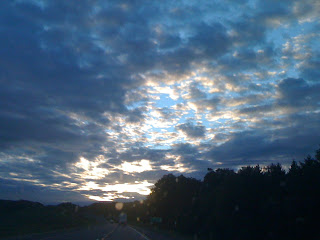 I had just crossed the state line between Maine and New Hampshire when Mick broke into Gimme Shelter. By the time I was nearly across Massachusetts, it was the Boss with Born in the USA on Boston's 104.5 FM. That's one of the funny things about New England, or so it seems to me, being from the mountain West. You can pick up a strong radio signal and follow it across the state. Of course, it helps if driving 50 miles places you halfway there.
Take today, for instance. I started out in Southern Maine and less than six hours later, had driven through portions of three more states (NH, MASS, NY), and completely across one of them (MASS). The same amount of time might have gotten me from the Colorado-Wyoming line to New Mexico or, had I been driving west from Dallas, somewhere still in Texas.
But it was a beautiful drive, especially once I got into the Berkshires, in the northeastern Appalachians. The colors are just starting to turn and the air is cool. By the time I come back through, on my way home, autumn may very well be past-peak, it's difficult to say. Then again, I may be posting photos that will knock your socks off.
So, tonight, I'm in Albany and tomorrow, heading west once again, this time along the Erie Canal. Remember the lyrics from elementary school? "Low bridge, everybody, down; Low bridge cuz we're goin' through a town. And you always know your neighbor, you always know your pal, if you've ever navigated on the Erie Canal." My sixth grade music instructor would never believe it.
(Photo of sunset in the Berkshires copyright 2010 by the author)

 One of the most frequently read essays in this blog is Medical School Through the Back Door. Based on a year as a psychotherapy intern and working as a member of a team composed chiefly of psychiatric residents, it relates how they, most of all, changed my life. I often wonder, though, what readers are looking for when they click the link for this story. The title is suggestive of an alternate route into medical school but the essay itself doesn't come with a map.
Reading back over it myself, what stands out is the way my resident and nursing friends adeptly reworded what I considered to be sound objections to attending medical school. I thought they were just being generous in an effort to make me feel better, and then I realized they were teaching me a vital skill. You see, we're generally accustomed to enumerating our personal liabilities and explaining why they prevent us from doing or being what we'd like. My friends showed me that liabilities can become assets if I'd open myself up to possibility.
For instance, the words "too old" were the first out of my mouth back then, followed quickly by the phrases, "I don't have a science background" and "I'm lousy at math." I wish I could create a picture for you of heads shaking in disbelief and verbal responses tinged with impatience and bordering on irritation. "You're older because you've got experience, you can take the science courses you need, and on top of that, all of us are lousy at math -- why do you think we're doctors (rather than engineers, one quickly added)?!"
In the 2003 film, Open Range, Annette Bening's character has a line that gets to the heart of the issue: I know that people get confused in this life about what they want and what they've done, and what they think they should have because of it. Everything they think they are or did takes hold so hard that it won't let them see what they can be. I wasn't trying to be obstinate -- truly, I wasn't. I'd just dressed up my background in clothes resembling limitations so frequently, it took some time to realize how wrong I'd been.
That's the task we all face, by the way, figuring out how to dress up our liabilities so they take on the characteristics of assets. And dressing them up is the thing; some we can eliminate, some we can't. I got the basic science education, passed the math courses, but there wasn't much I could do about the age card. I couldn't afford plastic surgery -- oops, there went a face-lift -- and besides, women like a man's face to have character. So, that left two choices: believe my own bad press or get busy maximizing the advantages of experience.
Reflecting on the kick in the pants given me by my friends, I think their advice boils down to this: take an inventory of all the reasons you think you can't do something and ask what you'd do if none of them existed. Once you've got the answer, then ask how those so-called reasons might actually help get you where you want to go, especially if you can't delete them at the press of a key. Be original. We want to get past the notion that we're too old, too unattractive, too fat, too skinny, too-God-knows-what, to start living. If there is a backdoor to medical school or anywhere else we truly wish to go, this is the place to begin looking.
(Screenplay by Craig Storper, copyright 2003. Creative Commons image by Scott Ingram via Flickr)

 Last night I felt a little like Arnold Schwarzenegger. Not in the sense that I've been approached about running for governor of California or suddenly developed a Mr. Universe physique. Being a medical student has headaches enough -- I think I'll pass on politics -- and believe me, I'm light years from looking like Adonis. No, it was Schwarzenegger as Harry Tasker in the film, True Lies, a mild-mannered computer salesman to his wife and daughter, and a spy to the rest of the world. It's the film in which Jamie Lee Curtis utters the line probably every man wishes his wife would at some point in their marriage, i.e. "I married Rambo."
Now, the similarity I felt didn't result from a backstreet run-in with terrorists or a secretive midnight flight to Geneva. It was more mundane than that; it came about when my dance instructor announced we'd be learning the Tango. If you've seen True Lies, you probably have a mental image of Schwarzenegger casually taking the time to dance a Tango with the gorgeous Tia Carrere while his buddies, monitoring his activity by radio, are going nuts because any second he could be discovered by the bad guys.
It made the evening fun, anyway, imaging myself learning skills that might come in handy if I'm ever called upon to serve my country under cover. I know, fat chance -- both of serving under cover and having Tia Carrere as a partner. But the Tango is very romantic and even going through the motions of learning it creates an air of sophistication that made me feel as though I should have been dressed in a tuxedo instead of jeans and sport shirt.
We only practiced the essential steps last night, which means we left out the part where the man appears to drag his partner across the floor. We did, however, include a sensuous move allowing the woman to lean tantalizingly close and then back away, but only so far as your arms will allow. You don't have to be Schwarzenegger, nor does your partner have to be a luscious female secret agent, to appreciate that. I suppose it helps, but there's always fantasy and on the dance floor, imagination can be as good as the real thing.
Even if it only turns you into a spy for an evening.
(Creative Commons image of the Tango by formfactor via Flickr)

 Now, let's see, what was that I said about not usually writing about politics? I must have gotten on a roll the past four days -- surprised even myself. Well, enough of that. Time to turn this young man's fancy toward something else for a change. Oh, I heard coyotes last night in the wee hours before dawn, a whole pack from the sound of them, yipping and yowling in the trees behind my house like a group of college students at a frat party.
You'd think, coming from the West, I'd have seen a lot of them "out on the lone prairie, where the coyotes howl and the wind blows free," as the old ballad goes, but I haven't. I only recall seeing one and while our acquaintance was brief, it was also deeply personal. I was living in Southern Colorado at the time, and driving home one afternoon a gray-brown streak on four legs darted across the highway in front of the car ahead. The driver swerved and tried to miss, but it was too late.
I pulled onto the shoulder and approached on foot, then took her by the legs and pulled her from the traffic lane. She was unconscious, breathing shallowly, and it didn't seem right to leave her to die alone. There wasn't anything I could do -- as far as we were from town, she'd have been gone before we reached the emergency vet clinic. She had a head injury and though it didn't appear severely traumatic, they'd have likely put her down, anyway. So, I waited with my hand on her side the few minutes until the end.
I'm soft-hearted where animals are concerned, I know, but I think of her when I hear distant relatives in the forest. Most human-coyote contacts aren't so intimate as the one that afternoon along the highway. They're a nuisance to some and a threat to those who raise small animals for a living. And, honestly, had she been conscious, I doubt my company would have all that welcome. But she didn't have much choice in the matter and neither did I. It was one of those times when all you can do is wait and offer comfort in those places where the wind blows free.
(GNU Free Documentation image via Wikipedia; Lyrics to Bury Me Not On the Lone Prairie are in the public domain.)

 Image via WikipediaAs a follow-up to yesterday's post, I've been thinking how the most recent presidential election in this country could be viewed as a shift with respect to social ambiguity. Anytime society undergoes change, ways of thinking and living will be challenged and our responses can range from open opposition to mild resistance, from moderate acceptance to enthusiastic embrace. That's pretty much a given.
In this country, the election of a president tends to be a marker predominantly indicating how registered voters (those who actually do vote, that is) feel about the direction society is taking. If things seem too uncertain or there seems to be too much departure from established norms, the trend will be toward conservative candidates. When change is in the air and people are feeling optimistic about new ideas, we favor liberal candidates.
If voting behavior can be taken to suggest comfort or discomfort with ambiguity, and if by my quick calculations, approximately 2/3 of the past 60 years have been under relative conservative presidential leadership, in general voters have preferred to lean towards certitude rather than incertitude. In other words, faced with changing social norms as a result of greater prosperity, multiplying avenues of self-expression, and the growth of a better educated and more sophisticated population, voters preferred someone who promised to slow or, perhaps in some cases, try to halt the rate of change.
2008 was a pivotal year because it resulted in the election of a candidate who represents a unique response to ambiguity, even more so than one might expect from "liberal" leadership. For one thing, he embodies it: Barack Obama is an individual of mixed racial heritage. As such, psychologically speaking, he is a transitional figure and not solely in a racial sense. He represents a willingness to look at ambiguity realistically and deal with it as an essential element in the make-up of the world community. Not in a radical sense of complete departure from our history and heritage, but a tempered response -- more than a baby step, less than a leap.
The fact that the children of Baby Boomers took such an active role in his election should tell us something. Issues that troubled their parents have little reference to their experience. They know nothing of the Cold War or duck and cover, November 1963 isn't a part of their collective consciousness, and their first car may easily be a BMW. The atmosphere in which they were raised was already fraught with change and they've adapted without a second thought. For them, the election of a Barack Obama would seem as normal as daily life.
Now, obviously, not everyone nor every young person, became his supporter and our national response to social and cultural ambiguity remains divided. And that, too, is to be expected. But what I think matters and will find its way into history is his potential to help us find effective ways of coping with uncertainty in a world that we sometimes fear has outgrown and moved on without us. Political considerations aside, I think his election represents a desire to proactively step into the currents of our time and make a difference in where they take us. They're going to flow anyway, we may as well learn how to swim; the alternative is to be swept along and for me, that spells unnecessary uncertainty.
(Collective Commons image via Wikipedia)
 Have you ever seen one of those mega-churches on television? You haven't? Oh, you've got to -- if for no other reason than to stay current on cultural trends. And in the name of culture, let's play with language for a second. Mega comes from ancient Greek and translates as (no surprise here) "big." But when we use it as a prefix, we usually mean something that's really big, and that describes the mega-church -- it's the kind that gives new meaning to the word huge.
I'm not going to mention names, tempting as it is, because I don't want someone from the Universal Church of Televised Numerical Superiority to show up on my doorstep with a Writ of You-Have-Been-A-Bad-Boy. Let's just say some are so big they look like indoor football stadiums and have to practically pass out binoculars with the morning bulletin in order to see the minister.
Please understand, I'm not trying to be offensive, it's just that empire-building comes to mind when I see these programs now and then, and that strikes me as alien to the nature of church as a community of faith. Now the reason I'm bringing this up today is because empire-building is a theme played out in the 2010 film The Book of Eli.
In case you haven't seen it, The Book of Eli takes place thirty years after a war that resulted in pretty much universal devastation. Earth and sky are colorless, the landscape is barren and windswept. Survivors live however they can, some having turned to cannibalism. In this milieu we encounter Eli, portrayed by Denzel Washington, a man with singular purpose: he has an extremely rare book -- the last copy of its kind -- that he wishes to get to an unnamed, unspecified location somewhere in the western United States.
In the course of his journey, he arrives at what could be loosely called a "town," seeking a charge for the battery on his i-pod, a remnant of life before the war. As it happens, Carnegie (Gary Oldman) the town's most influential person, has been searching for the very book in Eli's possession, convinced it has power and the one who wields it will control the growing, illiterate and impressionable populace. And he wants to be that one.
Eli, naturally, refuses to give him the book and conflict ensues. Eventually, Eli escapes, aided by a woman who has found him to be a man who may be trusted, something as rare in her world as the book is to the entire Earth. While we get glimpses of it's identity, only near the end does Eli name it, a King James version of the Bible. To save the woman's life, he gives the book to Carnegie, little good that it does him since it's written in braille, a language Eli has apparently learned and no one else remembers.
Eli is a pilgrim, and the woman becomes a disciple. He has a spiritual strength that she first experiences when he prays over their food, but he neither advertises nor seeks notoriety because of it. He's an ordinary, run of the mill person who has a vision to which he is determined to remain true.
The place where Eli and the woman finally end up is a library of sorts located on Alcatraz Island. It's ironic that one of the world's most infamous prisons is the source from which civilization will be reborn. He dictates the entire thing from memory before dying and it becomes the first volume issued by Alcatraz Press, much as the Guttenberg Bible was the first volume ever produced on a printing press.
The Road (see 8/9-10/10) is a film about hope; The Book of Eli is ultimately about faith and devotion: Eli's to a vision, the woman's to Eli. It's also about contrasts. For Eli, the message of the book is, "Do unto others more than you do for yourself." For Carnegie, it's a means to an end: dominance and control over the minds of the vulnerable. Eli dies having fulfilled his purpose, Carnegie dies in despair. Eli found meaning in his journey and the words he memorized, Carnegie lost everything and gained nothing.
Too many times we hear of ministers who have managed to build an edifice and watch it crumble at their feet because they gave in to greed, lust, or narcissism. Do unto others gets lost in the passion to do for self. Even Eli admits he'd gotten so absorbed in getting the book to the West that he momentarily had forgotten to live by it. It is easy to become so enamored with the trappings of faith and the semblance of spirituality, that one loses touch with its essential truth. And whether it be religion, politics, or the realm of interpersonal relationships, truth is the one thing that matters above all.
(Creative Commons image of Eli by scriptingnews)

 If you've ever gotten the impression that I'm not exactly up-to-date on the movie scene, you're absolutely right. I've got a list of excuses as long as my arm -- in excess of three feet, shoulder to fingertips -- but lack of interest is nowhere on it. I love movies and the latest Harry Potter flick got me hooked on IMAX and 3-D. All I have to do is walk into a theater and smell fresh popcorn, and it never fails, somewhere down inside I'm ten years old again.
Ultimately, the main reason I'm behind is cost. I'd betray my age if I told you ticket prices I recall, so as singer Jim Croce would say, "let's forget all that." My point is, it's darned near prohibitive, on a medical student's salary, to see first-run movies. And, unfortunately, the neighborhood movie house, as they used to be called, is a fond memory tucked away in American history. In case you don't know what I'm talking about, movies used to arrive first at downtown, upscale theaters. There they'd run for a few weeks before transferring to smaller, less expensive and less fancy theaters down the street from where most of us lived.
As a kid, Saturday afternoons were easily spent with my best buddy at the Woodlawn (isn't that a great name?), munching candy and watching double features. With the advent of the shopping mall and multiple screens, the local guys could no longer compete. Now, at least in my hometown of Denver, many of them have become venues for live music. That's a good thing, really, because it preserves the art deco architecture that was in its heyday in the 1920s and has become part of our cultural heritage.
Some towns, Dallas for example, have or used to have, dollar theaters. The seats weren't quite luxurious and the sound systems usually dated, but, hey, for a buck what can you expect? It was cheap and it beat paying several times that amount to see a film that had yet to go to DVD. The closest I can approximate that today is the automated dispenser at the grocery up the street.
True, my living room isn't the Paramount and the lounge chair I inherited from my parents isn't fitted with cup holders. Nor do I have the experience of surround sound and a screen wide enough to lose myself in the drama. But I can hit the pause button while I take my dog outside or skip backwards to hear a line that bears repeating in casual conversation. Peter Jackson and the Olympians was out in June and now it's available on DVD -- two months, that's not too bad.
The disadvantage isn't so much that I'm at a loss when someone asks what I think of the newest blockbuster. It's more that I don't have anyone to come around after "a night at the movies" to vacuum the carpet and collect the trash. I know, I need to have kids.
(Creative Commons image of Denver's Gothic Theater by DenverPam via Flickr; Operator by Jim Croce, copyright 1972)
 A friend of mine once said, "Cockroaches are tender-hearted. One dies and a million comes to its funeral." Advice for first-time medical students tends to be as prolific. Once you announce your admission, semi-serious and tongue-in-cheek comments range from "Is it too late to back out?" to "'C' is the correct answer for every test question you'll ever get." A lot of it is general, all of it is well-intentioned, but only some of it is really useful. What is most useful seems to come by experience and what follows has been mine.
To begin with, medical school, like the real world of medicine, is a communal endeavor. The person standing next to you in anatomy lab may turn out to be a valued colleague, even though at the moment they're struggling to keep their head above water. Competition was fine as a premed but now you have more important concerns than who's on first. Students committed to helping one another make lasting friends as well as a lasting impression, so be sure yours is a good one.
Second, despite the fact that you're about to be inundated with information, more than anyone could possibly absorb, digest, and retain, you will learn some things and you'll be surprised at how much. Not all of it is testable, however, and your mission, since you've chosen to accept it, involves ferreting out what is from what isn't. Make no mistake, this is a critical skill and the first week is not too soon to get coaching from upper classpersons about how to do it well.
Third, not everyone learns in the same way. There are students I've admired who can memorize in their sleep. Others are process-learners who need to explain and talk through the material. If you're one of these, don't tell yourself you have to know something before you describe it to a friend. Use your notes -- your instructors do. The point is to get the concepts into your head by whatever means, so they are available when you need them.
Fourth, I was about to say, don't wait until you're in trouble to ask for help, but I've changed my mind. It's difficult for medical students to admit to themselves, much less someone else, that things aren't going like expected. We have high expectations for our performance and assume others do as well. Getting past denial and facing the truth is tough. Just don't wait until you're in deep trouble to become honest with yourself. Trust me, as much as it hurts, you'll feel better once your problems are out in the open and you've got the people you need on your side.
Finally, even though I said medical school is a communal endeavor, it's also an individual one. For each of us, this is a once-in-a-lifetime experience that truly does go by, way too fast. It's incredibly precious -- gobble it up, enjoy it, revel in it. After four or five or however many years it takes, you'll be in residency because of what you've accomplished. Don't ever take it for granted and don't ever let it get old.
(Creative Commons image of the University of New England by Harmoney via Flickr) 
 Image via Wikipedia
As a kid, I was sort of disappointed that my father didn't have a lot of great, heroic tales to tell about his experiences in World War II. You know how it goes, the "Daddy, what did you do in the War?" kind of thing. He was a military policeman and when I asked him why he'd chosen that duty, he explained it was because of his accuracy with a .45 caliber sidearm. He'd qualified as an expert marksman, largely because he'd shot handguns on the ranch since childhood, and the military police wanted men who were "good with a gun."
As an adult, I've come to regard it a blessing that he didn't ship out overseas, because I have the sense, had he done so, his tales may have been more disturbing than thrilling. He enlisted when he turned 18 -- six days following the date his son would be born a few years later -- and finished basic training during the last six months of the War in Europe. One of the tasks of the military police at that time was to manage prisoners of war and to assist with victims of the Holocaust. I'm so glad he never had to have those memories.
Although he was adept at hiding it most of the time, my father was tenderhearted. He wasn't sentimental in a syrupy sort of way, but he'd draw my attention to baby animals, especially horses, in a field we happened to drive by. I've mentioned a saddle he made for my fifth Christmas -- turns out, all those evenings he came home late that month were spent in the shop, preparing for Christmas morning. Under the tough cowboy, man-among-men, exterior, was a nice guy who wouldn't speak badly about a person unless they were severely deserving. And even then, he never seemed to enjoy it.
Had he lived at the same time as his grandfather, I think he would have been a town sheriff. He could restore order where there was chaos and people whose lives were chaotic seemed to find him, even before he became a minister. They found him like kids find me. His shop was an informal counseling suite where truth was often found lying among scraps of leather or dancing to the tune of the hammering racket of his industrial sewing machine.
Dad was good at picking up the pieces and helping others do likewise. Because of that, I don't think he'd have brought PTSD home with him, had he gone away to war. If he'd been older, if he'd had a slightly different background, I think he'd have gone into the chaplaincy or medicine. And if medicine, I think he'd have found his way to psychiatry. And if psychiatry, he'd have been a healer, since that's what he was anyway, and the scarred from war would have been his patients -- or his congregation.
Happy Memorial Day.


Well, I've gone and done it, i.e. set a date for a repeat performance with board exams this year. June 22 at 8:00 AM in one of the seacoast towns across the Maine-New Hampshire state line. I've held off intentionally, wanting to schedule when it felt right and preserve some sense of control over the process or at least my responses to it.
If I've got any advantage this time, it's due to having taken boards once before; I'm a veteran. I haven't slept in the trenches or slogged my way through muddy marshes, but I've seen my enemy face to face and lived to tell the tale. Board exams are an eight to nine hour marathon combining brain-strain with physical endurance. Even with scheduled breaks, it's exhausting.
So, how does an older student prepare for an experience like this? The assumption you run into is that age somehow slows down the mechanism. Biology is supposed to work against you like moisture on a piece of metal left out in the barnyard too long -- you got it, rust forms. It's hard to convince those who've never been in your position that things don't have to turn out that way. Common assumptions can easily be false ones.
You start like anyone else with a lick of sense, as my father used to say. Make sure you're in shape. Exercise, lose some weight, build stamina, and eat better. Add more fruit, lose the refined sugars (I don't mean chocolate, but maybe cut back a little), and drink more water -- it keeps you hydrated and improves learning and memory retention. The exam itself, however, involves sitting for two hours, then a break, then two more hours, etc. It makes sense to try to simulate those conditions, so that E-Day (exam day) is like any other, at least where your backside is concerned.
Regarding the material itself, instead of trying to review the whole of medical school in the next three weeks, I'm using a question bank that evaluates my progress and shows me which specific areas need work. "High yield," I'm discovering, doesn't necessarily mean trying to outguess the test designers as much as shoring up my weaknesses. The main thing is to feel confident and capable based on practice and adequate preparation, since boards, in the words of one of my classmates, are first and foremost, a "head" game.
"That's all well and good," say the assumers, "but it still has to be harder, being older." Truthfully, I wouldn't know, since I never tackled medical school and board exams when I was younger. I have nothing to compare this to. Honestly, it's tough for all of us. And even if it was tougher, that only makes the long-term rewards all the more precious and the celebration, when you walk across the stage with degree in hand, just that much sweeter.
(Public Domain image via Wikipedia)
 Well, as my father used to say, it's all over but the shouting. The majority of members of my entering class are now, and ever will be, Doctors of Osteopathic Medicine. For all of us who were present at graduation, it was truly a triumph -- everything we've shared and suffered together has paid off in spades. It's hard to know where to begin this morning, because at one point yesterday I thought I must have gathered enough material for a week's worth of posts, and it may just turn out that way.
Two things, however, are perched at the forefront of my mind and it's probably best to start with them. One advantage of being an usher at these ceremonies is, you usually have your selection of the best seats. In my case, I was able to choose one right next to the steps that led onto the stage where hooding was to take place. As a result, I had the privilege of shaking hands with every one of my classmates as they passed by.
With each, memories of our first year came unbidden. Sitting in lecture with a future colleague who initially wanted to be a family doctor. Since then, he's come to love psychiatry with a passion that rivals mine, and we've formed a warm and lasting bond. Three with whom I spent long hours bent over a cadaver and so many others whom I've touched and who have touched me in OMM lab. In some cases, we cast aside formality like crumpled paper and hugged and kissed freely. I wouldn't have been anywhere else in the world.
Near the end of the ceremony, my classmates stood to take their osteopathic oath and I stood with them off to the side of the auditorium. I couldn't have sat at a moment like this, my legs wouldn't have permitted it. We've gone through too much, shoulder to shoulder, to merely be an observer. Like Stephen Hopkins, delegate from Rhode Island at the Continental Congress, who wished to remember the faces of the signers of the Declaration of Independence, I wanted to see the faces of my friends as they spoke. I, too, wished to remember.
As family members gathered round during the reception that followed and I was introduced to parents and siblings, it felt unusually familiar, almost as though I was meeting members of my own family for the first time. And it only makes sense, since coming to medical school for me, has been like coming home. Later, as I walked to my car, one of my classmates passed with his fiance, and he waved a roll of nondescript cardboard in the air that could have been photographs or a movie poster, but it wasn't. "There's one of these with your name on it, don't forget," he said with a grin.
It was his diploma and he's right, there is.
(Photo by the author, copyright 2010)


It must be like having sympathy labor pains. Some guys get them when their female partners are close to delivery. This is psychosomatic, of course, the brain creating the sensation of cramping under the influence of a profoundly psychological motivation. The intimate connection between mother-to-be and her male partner becomes incarnate in a mutual physical experience. I think it's really quite wonderful when it happens.
This morning, I'd planned on being asleep at 5:30 and finally gave up the ghost and climbed out a few minutes after 6:00. At first, I thought it was because I was anxious to get a head start on the day and then I remembered. My incoming class has the first of two graduation ceremonies at 9:30 -- their alarms were probably set to go off right about now. Whatever wag said my class goes through medical school as though joined at the hip, got it exactly right.
I know it sounds unusual to have two ceremonies, so let me explain. The first is for the entire university, and while this is something new for us this year, I'm told it's pretty common elsewhere. The second is the one we care most about, when hoods are placed on our gowns symbolizing the doctoral degree, and we take the Osteopathic Oath, formally becoming osteopathic physicians. This is the point at which parents get out the tissues.
It's traditional for hooding to be done by someone who is either a physician or has a doctoral degree, representing the "passing on of the mantle" of responsibility. I've seen physician-siblings and parents in this role as well as professors who've been instrumental in one's career. Two years from today, my best friend, an MD psychiatrist, will do the honors, along with many others present in spirit.
There is a sense in which all of this is anticlimactic, because, although my classmates will be licensed physicians, they can't simply hang out a shingle reading, "Open for Business." I've heard it said jokingly, we give you a degree but we won't let you do anything with it until you've completed residency, or at least not without supervision. But the degree is their admission ticket to residency and from my own experience with residents, this is when the real fun begins.
You know, I've been an usher for two previous graduations and this will be my third, but I've never before had the feeling that one of them was mine. This morning I feel that way. It's as though, being a part of this incredible group of people, I'm crossing the threshold of a vast room -- a spiritual space, if you will -- the length of which will take two years to traverse. At the other end is a tiny, intensely bright light -- so bright I can barely look at it without squinting -- and when I reach it, my friends will be there, not a single one of them asking, "What took you so long?"
(Public Domain image via Wikipedia)

It makes good fiction to say, "it dawned raining this morning," but the fact is, I wasn't awake to see it. All I know for sure is it's rainy now and the clouds were moving in late last night. Have you ever thought of all the different ways it rains? For instance, it's probably accurate to say we're having light rain at the moment, which is nothing more than regular rain without all the fat and calories. Sometimes it falls in sheets, at which point I get to replenish my linen closet, and when it pours I find out what a mug feels like, standing under a beer tap.
In any case, I'm glad I finished mowing the yard yesterday. Until I moved to Maine I'd never driven a riding mower. Growing up, those were the toys of the rich and famous. Here, if I had to depend on pushing Old Bessy, that's all I'd do from sunup to sundown. The one I have is a hand-me-down from the previous owner, replete with torn seat and manual choke. It's loud enough to wake the dead, tips eerily going sideways down the hill toward the hayfield, and it will never win a lawn mower race, but it gets the job done.
I've grown rather fond of that mower, actually, and I've taken to giving it a pat and "good job" at the end of the day. I don't suppose the encouragement will keep it out of the shop, but it makes me feel good anyway. Speaking of feeling good, I've noticed something the past few months.
When I moved here, I brought my Colorado tradition of waving to everyone who passes, with me. I figured country folk are the same everywhere and since this is the country, things shouldn't be any different. Well, it turns out they were and I was the only one who did it. At first, I felt like a fish out of water, but I decided if it was good enough for Colorado, it was good enough for Maine, and a little change never did anyone harm. So, I waved and pretty soon, everyone was waving back. If I'm driving down the road and forget, they wave anyway. It's not much, it probably won't change the world, but it makes people feel connected, a little less alone, and that feels good.
(Creative Commons image by matt.wagers via Flickr)

I've had an idea lately that I really can't prove -- it's purely speculative -- and it is that much of our misery as adults stems from ignoring what we considered important as children. It may have for its inspiration, the AARP commercial that presents a series of over-40 adults, each one telling the audience what they want to be when they grow up. It gets your attention because of the incongruity; you usually expect something like this from kids. But here they are, people who, ordinarily, should have had their act together for a long time, talking about what they'll do, when they do.
The implication, of course, is its never too late to reinvent yourself and its only too late to stop trying new things when we're six feet under. But there's something about the ambitions of childhood that makes them surface in late-night party conversations among close friends, long after the casual (or uninteresting) guests have gone home. Someone asks, rhetorically, if anyone ever imagined doing what they are when they were kids, and it takes off from there.
What I think is happening is, an attempt to create a sense of continuity between who we imagined ourselves to be and the person we've become. And I think it's discontinuity between these two that generates a lot of the dissatisfaction that can bring adults into therapy. The feeling that one has gotten "lost" somewhere, or they don't recognize themselves when looking into the mirror.
I'm not suggesting the solution is to walk into the boss's office on Monday morning with a note reading, "Goodbye, farewell, this is it," and then set off on a quest to become whatever. But I do think ignoring what we once thought important is like dismissing a critical part of ourselves as unimportant, producing a tenderness that is easily irritated and we can't say why.
What we dismiss has the tendency to become associated, over time, with shameful, and what we associate with shame gets hidden. Hiding saps energy and promotes defensiveness. When others come too close, we find ourselves irritable, and that's why. Getting reconnected with oneself nurtures wholeness and a feeling of being at peace. It's not as scary as it sounds and most of the time we're not alone. It's part of growing up.
(Creative Commons image via Wikipedia)
 I can't say I've gotten hooked, but I will admit to having become fond of the television show, Criminal Minds, about a team of FBI profilers who attempt to unravel the criminal mind from week to week. For one thing, it's refreshing to see a depiction of psychiatrists and psychologists that doesn't place us in compromising positions. For another, I enjoy their portrayal of what it means to "look into the darkness" of human experience and struggle with its effect on the characters.
I've was thinking about my post yesterday when I realized I ought to own up to my proclivity for drawing attention to problem areas within relationships. It's an occupational hazard since, most of the time, people don't come to someone like me when things are going well. It's true, former patients will drop by or write to let me know how they're doing, but that's different. When we first meet it's because they aren't doing well.
Sooner or later, if you've done enough of this kind of work, you start wondering if there might a way to "head things off at the pass," and engage in some preventative care. Wellness is what we call it in medicine, i.e. taking better care of oneself, eating right, and getting proper exercise. The same things our mothers told us would keep us as healthy as great, great, great granny, who outlived five husbands and is still playing golf in Florida.
The thing I've discovered is most people don't intentionally get themselves into a painful situation. Willfully, yes, in the sense they've made their own choices, but not intentional in a way that suggests they always knew what they were doing. In retrospect, they see it, but in prospect, they didn't and came to wish they had. When I'm not helping pick up the pieces, I think about those things and try to put them into words a disinterested party might read and say, "Mm, that makes sense." It's my way of looking into the darkness, placing a light at its brink, and to paraphrase Dante, saying, "Weary traveler, beware, there be dragons here."
(Creative Commons image by kizette via Flickr)


